|
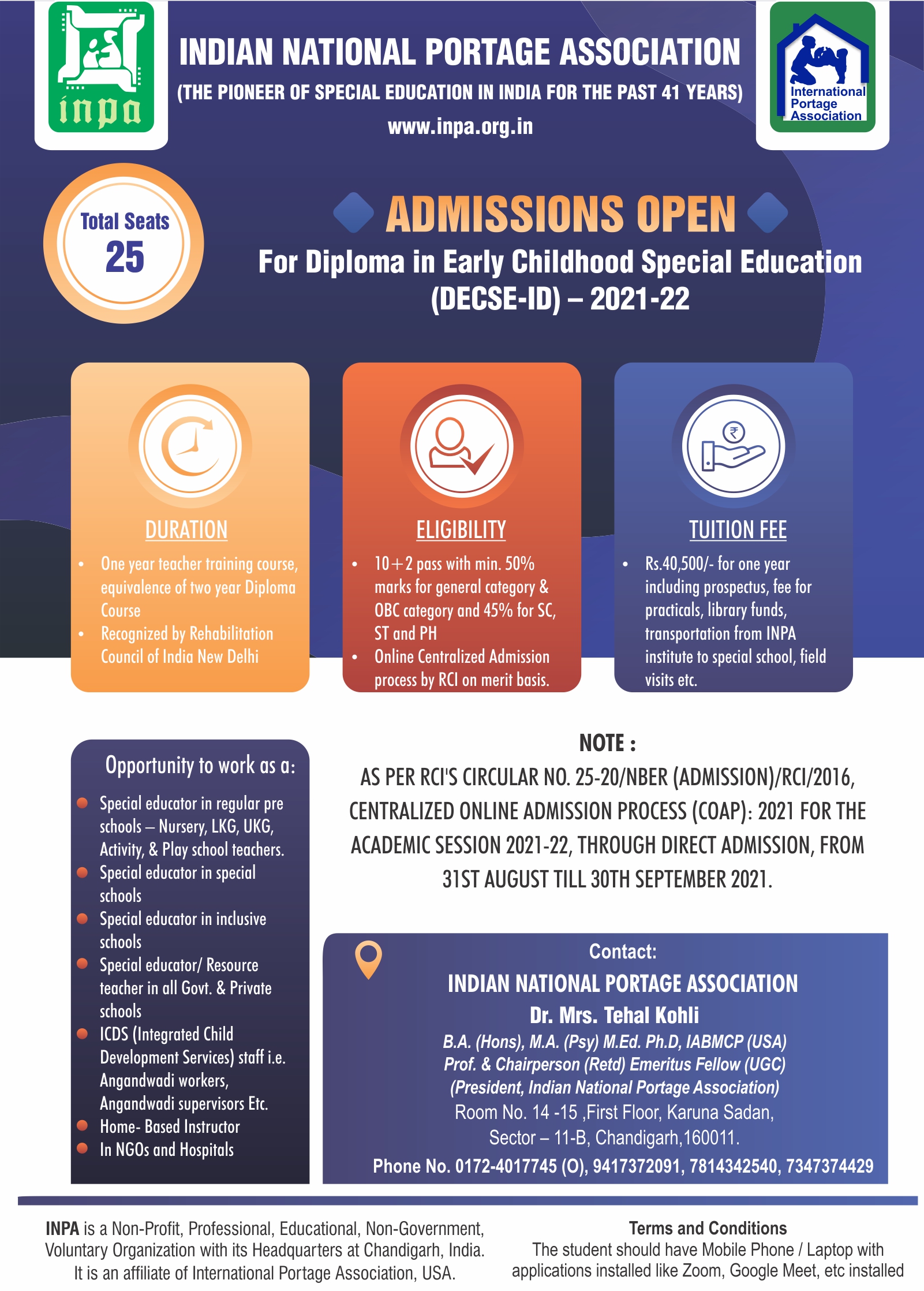
Diploma In Early Childhood
Special Education (Mental Retardation)
Mode of Education - Face to Face
Registration & Prospectus: Rs. 1500 /-
Course Fees: 16,000/- + 5000/- Annual funds +
4000/- for Lab. and
Library Last Date for submission of Application Forms:
As per guidelines of RCI / IGNOU
Last Date with late fees of Rs. 500/- for submission of Application
Forms: As per guidelines of RCI / IGNOU
Duration: 1 year
Eligibility: 10+2 or above
Rehabilitation Council of India's (RCI) Course.
Centre Code: 9071
Introduction
The training programmes in India, currently focuses on
persons with Mental Retardation at school going age and vocational
age. The importance of early detection and suitable training and
management is well known. Early childhood education has emerged as
an important area of interest. Children with developmental delay
(DD) or at risk for Mental Retardation certainly need supportive
education in early years of life. Currently, there is a worldwide
trend towards enhancing support through early childhood special
education. This being the critical period, appropriate intervention
at the right time arrests further damage and helps parents mould
their attitude positively towards management of the child with
DD/Mental Retardation.
Objectives of the Course
- Human resource development
- Research and development
- Development models of care and rehabilitation
- Consultancy services to voluntary organisations
- Documentation and dissemination
- Extension and Outreach programmes
NATURE OF THE COURSE
Early Childhood Special Education (ECSE) focuses on children
below 6 years of age and has various modes and approaches in
imparting training based on the ability of the target group. This
could be home based training, centre based training, placement in
regular pre-schools, Anganwadis or Balawadis. This demands training
of human resources suitable to reaching out to the families by being
a home visitor or itinerant teacher, to manage children with
disabilities in regular or special pre-schools. The early childhood
special educator is also expected to work as a member in a
multi-disciplinary team for designing and managing the curriculum,
to enhance inclusion of the disabled children alongside the
mainstream population. To provide all of these competencies, a
programme leading to Diploma in Early Childhood Special Education is
being offered at INPA, Chandigarh.
Objectives
-
To provide competencies among trainees in areas
of early detection of disabilities, assessment, programming and
evaluation.
-
To train them to work as a member in a
multi-disciplinary team.
-
To provide teaching strategies in ECSE, in
various pre-school settings.
-
To be an effective link between home and the
school.
-
To prepare the children for primary school
education.
Scope & Placement Opportunities
Placement opportunities to work as Early Childhood special
Educator:
- In regular preschools.
- In Special schools in classes for pre school children.
- In research projects on ECSE/ECE.
- Coordination of Anganwadi Centres and any Govt or Private
pre - school centres including children with special educational
needs.
- To be a home based instructor and/or itinerant teacher for
pre school children with developmental delays.
- Any school programme special / regular schools working
towards inclusion of special children in regular pre-schools
Eligibility
Minimum educational qualification for admission to the course
will be, successful completion of ten plus two or equivalent
examination with 50% marks for candidates belonging to general
category and 40% for reserved category as prescribed by Govt. of
India.
Admission Criteria
Educational Qualification: 10+2 : 60 marks
Preferential weightage for candidates for Science/Engineering stream
: 10 marks
Weightage for experienced / sponsored candidates : 05 marks
Parents / siblings of persons with mental retardation : 05 marks
Interview : 20 marks
TOTAL : 100 MARKS
Selection
Application for admission will be screened and short listed
on the basis of three candidates per seat by a committee specially
constituted for this purpose. Merit list based on the academic
qualification as per the rules will be prepared. Final merit list
will be prepared based on the scores obtained by the candidates on
the basis of academic qualification, experience and performance in
the interview. TA/DA will not be paid by the institute for attending
the interview. No candidate is allowed to change the course of study
and centre once admitted and if he/she is still desirous to joining
any course within the Institute or at any other place, the fee/
deposits remitted to the Institute shall be forfeited.
Joining & Submission of Certificates
Selected candidates should join the course by the stipulated
date. At the time of joining the course, the selected candidates
will have to produce. a) Undertaking to the effect that the admitted
candidates will not discontinue the course and b) Medical
certificate of fitness from a Civil Surgeon declaring the state of
health.
Number of Seats
The total number of seats are Twenty Five (25) of which
"three" (3) are reserved for SC, "Two" (2) for ST and "One" (1) seat
for those with physical handicap with locomotor disability in one
lower limb. In case no candidate turn up for the reserved seats,
they will be declared open.
Duration of Course:
One academic year i.e., ten calendar months comprising of 220
working days, 8 hours per day, 5 days a week. There will be an
internship of 3 months duration, subject to instructions from RCI.
Medium of Instruction
Delivery of lectures will be mainly in English. However,
candidates will be allowed to write the Final Exam in Hindi, English
or Punjabi.
Attendance
Minimum attendance 80% is essential to be eligible for
appearing for the examination. 100% of the practical work and
assignments should be completed and certified by the respective
staff prior to the examination. If due to illness, the student is
unable to complete the target, production of medical certificate can
be considered. However, the final decision of allowing for
examination will be taken by the competent authority.
Any shortage of attendance will have to be made up before the final
examination by the student concerned and the institute does not take
responsibility whatsoever in arranging theory and practical classes.
The applications of those candidates with shortage of attendance
will not be considered for issue of hall tickets to appear in
examinations.
The Institute reserves the right to cancel the admission if the
candidate admitted is found to be habitually absent or is not
putting up the required attendance or is not making significant
improvement in studies or not taking interest in pursuing the course
of study.
The guidelines pertaining to the examination procedures prescribed
by the Rehabilitation Council of India shall be adopted.
Examination
Examination will be conducted in English/Hindi/Punjabi
language. A minimum of 40% in each theory paper with an aggregate of
50% in all the theory papers is requested for passing the theory
while a minimum of 50% is essential for passing in practical. A
combination of internal and external will be followed for theory
papers.
For practicals, it will be both internal and external as per course
structure. The examination will be conducted for individualized
family service programme (IFSP), group teaching and therapeutics and
evaluation will be done by the internal an external examiners.
Record submission of IFSP will be made during final examination
where external examiner will ask questions during viva. External as
well as internal examiners marks will be considered for finalizing
the marks.
The student will also be given opportunities for improvement of
marks in the particular examination by reappearing in the specific
paper in the next examination. The guidelines pertaining to the
examination procedures prescribed by the Rehabilitation Council of
India shall be adopted.
Periodic Evaluations
There will be a minimum of two term examinations and two
tests during the training course in all theory subjects. Practical
activities will be tested throughout the year. The marks obtained by
the trainee teacher shall be entered in the marks register of the
centre.
Course Content
The course has about 40% theory and 60% exposure
on practicals as prescribed by RCI. The theory and practical papers
covered are given below:
Theory
Paper-I Introduction to Early Childhood
Special Education (ECSE)
A. Nature and needs of children with Developmental Delay/ Mental
Retardation
B. Early childhood special education - Issues and Trends
Paper-II Child Development and Learning
A. Child Development
B. Learning in children during early years
Paper-III Organization of Early Childhood Special Education
Programme
A. Identification and Assessment
B. Planning and Management of Early Childhood Special Education
Programme
Paper-IV Curriculum and Teaching Strategies
A. Curricular adaptation
B. Teaching strategies, method and materials
Paper-V Inter-disciplinary Aspects in ECSE
A. Therapeutics
B. Working with families
Practicals
Paper-I Individualized Family Service Programme
Paper-II Group Teaching
Paper-III Therapeutic interventions
Award of Diploma
Based on the performance during the course and on
the annual examination, the successful candidates will be awarded
Diploma in Early Childhood Special Education (MR). Minimum marks for
passing examinations will be 40% in each paper with aggregate of
50%. Candidates scoring 70% and above will be awarded the Diploma
with Distinction. Candidates will be deemed to have failed in the,
examination if they score less than 40% marks in the theory or
practicals. The unsuccessful candidates will be allowed to reappear
only in theory examination upto 3 attempts to complete the course.
If a candidate has failed in any of the practicals he/ she will be
required to appear in all the theory and practical again.
Faculty
In addition to two core faculty if needed
competent guest faculty with experience will be arranged as per
requirements of the topics given in the syllabus.
Discipline
The candidates admitted should abide with
discipline within the prescribed administrative regulations and also
avail the hostel accommodation as provided the candidates are
expected to maintain decorum, decency and discipline throughout
their pursuance of the course with the staff faculty co- students
and other supporting staff.
|